Milk of Murrah buffaloes bred in São Paulo (Brazil): influence of age, lactation phase, time of milking and bacterial isolation in the physical-chemical and cell composition
DOI:
https://doi.org/10.36440/recmvz.v9i3.16Abstract
The objective of the present study was to evaluate physicalchemicaland cellular contents of the milk of buffaloes bred inthe state of São Paulo, Brazil, and to draw relationships betweenthese values and microbiological results, contributing significantlyfor the diagnosis of different forms of mastitis. Reference valuesfor buffalo milk, according to the phase of lactation (beginning,middle and end of lactation) were, respectively: pH, 6.89; 6.85and 6.9; electro conductivity, 3.82; 4.02 and 4.49 mS/cm; chloridecontent, 18.72; 20.13 and 26.49 mg/dl; fat content 4.25;3.70 and 3.56 g/dl; protein content, 3.97; 4.03 and 4.5 g/dl;lactose content, 5.11; 5.08 and 4.81 g/dl; total solid content,14.55; 13.88 and 13.93 g/dl, and somatic cell counts, 29,000;29,000 and 26,000 cells/ml. Results support that the phase oflactation influence pH, electroconductivity, chloride, fat, protein,lactose and total solid contents, as well as somatic cell counts.Fat, protein, lactose, total solid and somatic cell counts contentswere influenced by the moment of sample collection (before orafter milking), respectively, with the following values: 3.90 and8.9 g/dl; 4.12 and 3.67 g/dl; 5.02 and 4.64 g/dl; 14.18 and18.31 g/dl, and 29,000 and 56,000 cells/ml. Bacterial generamore frequently isolated were Corynebacterium sp (28.5%); Staphylococcussp (24.7%); Streptococcus sp (15.8%); and Arcanobacteriumpyogenes (11.4%), with prevalence equal to 20.1%.The frequency of bacterial isolation increased significantly withlactation. However, the moment of milking did not influence isolation.There was a relationship between the variation in somemilk constituents that present clinical significance for the diagnosisof buffalo mastitis.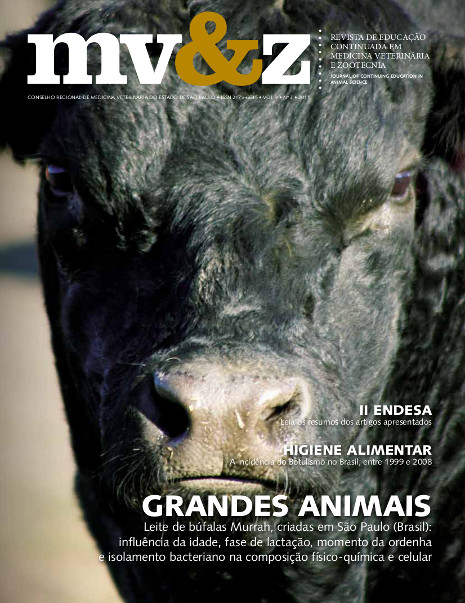
Downloads
Published
Issue
Section
License
1. Autores mantém os direitos autorais e concedem à revista o direito de primeira publicação, com o trabalho licenciado sob a https://creativecommons.org/licenses/by/4.0/.
2. Autores têm autorização para assumir contratos adicionais separadamente, para distribuição não-exclusiva da versão do trabalho publicada nesta revista (ex.: publicar em repositório institucional ou como capítulo de livro), com reconhecimento de autoria e publicação inicial nesta revista.
3. Autores têm permissão e são estimulados a publicar e distribuir seu trabalho on-line (ex.: em repositórios institucionais ou na sua página pessoal) a qualquer ponto antes ou durante o processo editorial, já que isso pode gerar alterações produtivas, bem como aumentar o impacto e a citação do trabalho publicado (Veja O Efeito do Acesso Livre).
How to Cite