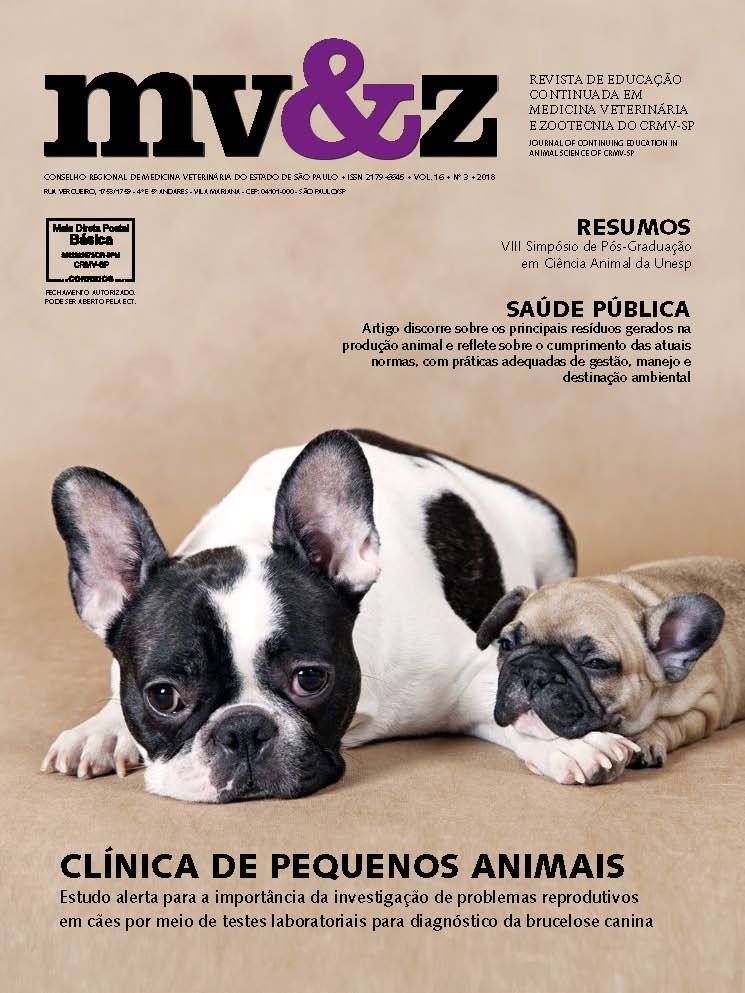
Brucellosis outbreak in a commercial kennel: a case report
DOI:
https://doi.org/10.36440/recmvz.v16i3.37818Abstract
Brucella canis is a facultative intracellular bacterium responsible for brucellosis in dogs, a chronic and zoonotic infectious disease endemic in Brazil, which promotes reproductive failure and involvement of the lymphoid and articular systems. The infection has been commonly described in breeding kennels, being difficult to treat and control. This study reports an outbreak of brucellosis in a commercial kennel in Guarulhos, SP, Brazil, comprised of 32 dogs (four males and 28 females) from five different breeds, where episodes of abortion had been happening since October 2015. Brucellosis was considered a potential cause of reproductive impairment only a year and a half after the first episode. Anamnesis, clinical examination and serological and bacteriological tests were conducted in all dogs. Of the 32 dogs, 28 had at least one clinical sign compatible with brucellosis, with increased lymph node volume and abortion being the most frequently observed signs. Twenty-six dogs had positive results in at least one of the laboratory tests used for the diagnosis, indicating the infection’s prevalence to be 81.25% in the kennel. Regarding microbiological diagnosis, B. canis was isolated in blood samples of 22 dogs, in vaginal swabs of nine females and in semen or preputial swabs of two males. Twenty-three dogs had positive results in the serological test. After the introduction of the infection into a confined canine population, it can spread rapidly leading to great reproductive losses. The high prevalence observed in the kennel was probably associated with the delay in the infection’s investigation using laboratory tests after the first abortion episode, as well as the existence of practices favoring the introduction and rapid spread of the infection. Thus, the present report highlights the importance of the immediate investigation of reproductive problems in dogs, via laboratory tests for the diagnosis of canine brucellosis.
Downloads
Published
Issue
Section
License
1. Autores mantém os direitos autorais e concedem à revista o direito de primeira publicação, com o trabalho licenciado sob a https://creativecommons.org/licenses/by/4.0/.
2. Autores têm autorização para assumir contratos adicionais separadamente, para distribuição não-exclusiva da versão do trabalho publicada nesta revista (ex.: publicar em repositório institucional ou como capítulo de livro), com reconhecimento de autoria e publicação inicial nesta revista.
3. Autores têm permissão e são estimulados a publicar e distribuir seu trabalho on-line (ex.: em repositórios institucionais ou na sua página pessoal) a qualquer ponto antes ou durante o processo editorial, já que isso pode gerar alterações produtivas, bem como aumentar o impacto e a citação do trabalho publicado (Veja O Efeito do Acesso Livre).
How to Cite